Download
- Paper and mathematical appendices (arXiv -> submitted)
- CompleNet 2026 Presentation
- Code and experiments
Abstract
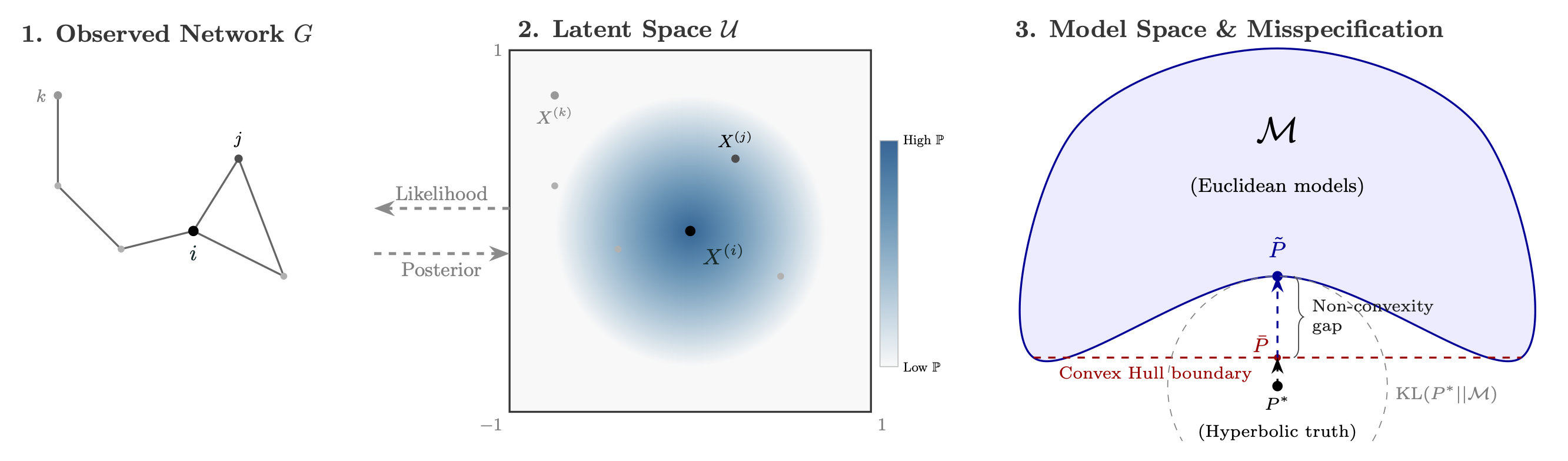
Bayesian latent space models offer a principled approach to network representation, but rely on correct specification of both geometry and link function. Real-world networks often violate these assumptions, exhibiting geometric mismatch and structural anomalies that break standard metric properties. We show that such misspecification pushes the data-generating distribution outside the model class, causing Bayesian inference to become overconfident and poorly calibrated. To address this, we propose a generalized posterior framework for random geometric graphs. We introduce Link-Sequential R-SafeBayes, a method that exploits dyadic conditional independence to estimate prequential risk and adaptively tune posterior regularization. Experiments on synthetic and real-world networks demonstrate improved calibration, better link prediction performance, and a reliable criterion for selecting latent geometries across Euclidean, spherical, and hyperbolic spaces.
Figure 1: The Misspecification issue

Citation
Labarthe, A. (2026). Bayesian Latent Space Models for Graphs Are Misspecified: Toward Robust Inference via Generalized Posteriors. arXiv preprint arXiv:2605.XXXX. https://arxiv.org/abs/2605.XXXX
@article{labarthe2026misspecification,
  title={Bayesian Latent Space Models for Graphs Are Misspecified: Toward Robust Inference via Generalized Posteriors},
  author={Labarthe, Aldric},
  journal={arXiv preprint arXiv:2605.XXXX},
  year={2026}
}